Wearable silent-speech interfaces
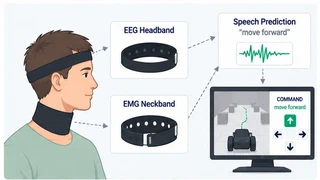
Silent-speech interfaces decode speech-related intent from physiological signals, enabling private and accessible communication, but existing approaches rely on obtrusive sensing and struggle to stay robust across sessions. This research explores unobtrusive, wearable interfaces with on-device processing.
- Contributions — conceptualised SilentWear, a fully wearable, dry-electrode textile sEMG neckband built around the BioGAP platform; conceived and ran multi-day, multi-subject studies with vocalised and silent speech; developed SpeechNet, a compact 15k-parameter CNN for edge deployment, with a personalised fine-tuning strategy for inter-session robustness.
- Results — 8-command recognition across 4 subjects: 84.8% / 77.5% accuracy (vocalised / silent, aggregated evaluation); fine-tuning recovers > 10 percentage points of accuracy lost to repositioning within < 10 min of personalisation; 2.47 ms inference at the edge (GAP9).
Now: EMG, EEG and audio fusion for continuous speech recognition.

Authors
PhD Researcher · Wearable Multimodal Neuromotor Interfaces at the Edge
I am a PhD researcher at the Integrated Systems Laboratory at ETH Zurich. My research focuses on
next-generation wearable, multimodal neuromotor interfaces for novel human–machine interaction strategies.
Bringing together surface electromyography (sEMG), A-mode ultrasound and inertial (IMU) sensing, I work
across the full pipeline: from wearable form-factor development and system integration to machine
learning for physiological signal decoding, on-device deployment and validation through human-subject
studies, towards end-to-end, user-centred solutions for real-world use cases.