Foundation models for the edge
Feb 1, 2026
·
1 min read
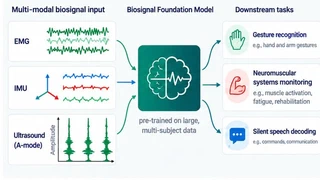
Foundation models can learn transferable representations from physiological signals, reducing the need for task-specific models and labelled data. However, variability across acquisition systems, subjects and tasks challenges generalisation, and computational cost limits wearable deployment. This research investigates compact foundation models that bridge transferable representation learning and edge inference.
- Contributions — conceived TinyMyo, the first EMG foundation model at the edge, and defined its research direction: dataset unification, the pre-training framework and multi-task downstream evaluation; supervised its development and experimental validation within a Master’s thesis.
- Results — a 3.6M-parameter transformer backbone evaluated on gesture recognition (NinaPro DB5, UCI-EMG, EPN-612, Generic Neuromotor Interface by Meta), kinematic regression (NinaPro DB8) and silent speech (Gaddy). Deployed on GAP9, where a 1.9M-parameter variant achieves 89 ms inference on 1-s windows.
Now: foundation models for A-mode ultrasound at the edge.

Authors
PhD Researcher · Wearable Multimodal Neuromotor Interfaces at the Edge
I am a PhD researcher at the Integrated Systems Laboratory at ETH Zurich. My research focuses on
next-generation wearable, multimodal neuromotor interfaces for novel human–machine interaction strategies.
Bringing together surface electromyography (sEMG), A-mode ultrasound and inertial (IMU) sensing, I work
across the full pipeline: from wearable form-factor development and system integration to machine
learning for physiological signal decoding, on-device deployment and validation through human-subject
studies, towards end-to-end, user-centred solutions for real-world use cases.